

Birthday
In Between Lives: An Artist and Her World, Dorothea Tanning recounts her first meeting with Max Ernst and the moment he saw Birthday and gave it its title.

My dearest incurable humanist,
It is my birthday today, April 7, and I find myself thinking about time, stages, and thresholds. That is what led me back to Dorothea Tanning, especially her painting Birthday (1942), her memoir Birthday (1986), and its expanded version, Between Lives: An Artist and Her World (2001). Tanning has long been one of my favorite artists, though she has not always received the attention her work deserves. Perhaps her marriage to Max Ernst has too often overshadowed her, but her art demands to be seen on its own terms.
What fascinates me most in Tanning’s work is her use of doors. They appear as passages into another reality: dream, fear, desire, and the unconscious. In Birthday, Tanning presents herself standing in a narrow interior, dressed in a lavish, purple, feathered garment that slips open to reveal her torso. She faces outward with a composed, direct presence, while a small creature curls at her feet and a series of open doors recede behind her into an uncertain depth. The room is rendered with deliberate spatial instability: the floor tilts, the architecture feels compressed, and the doorways create a cascade of passageways. Tanning turns the self-portrait into a threshold image, making the figure seem poised between visibility and transformation, intimacy and estrangement.
In a catalog text she described her desire “to seduce by means of imperceptible passages from one reality to another,” and to make a picture “without any exit at all”. That sentence feels central to her art. Her paintings unsettle the viewer, drawing us through a sequence of ambiguous openings until we realize that uncertainty is the point.
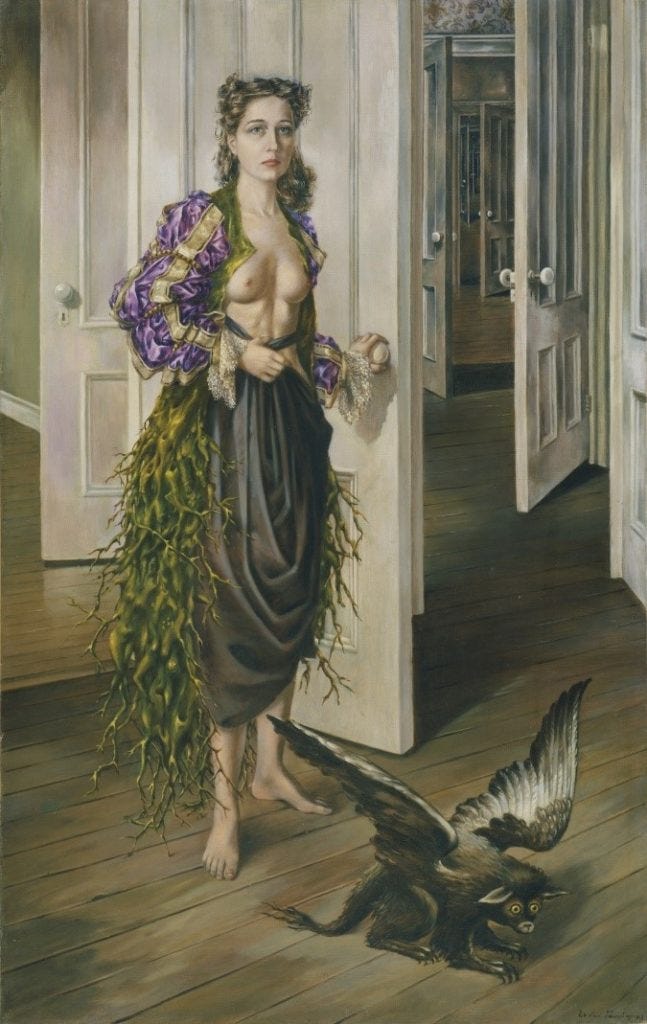
Birthday feels like the feeling of being suspended between worlds, unable to settle into a single stable reality. Her doors are thresholds to disorientation. Yet that disorientation is also where imagination begins. Tanning understood Surrealism as a way of thinking. In an interview with Carlo McCormick, she rejected simplistic readings of the work as merely autobiographical or merely feminine. For her, Surrealism was philosophical before it was visual, rooted in thought, dream, Freud, and the instability of reality. That helps explain why she resisted reductive gendered labels and insisted that her work should not be confined to categories that diminished its scope.
The memoirs deepen that world. Birthday was first published in 1986, and Between Lives later expanded it with new memories, reflections, and encounters. Read alongside the paintings, these books show an artist who was also a writer of considerable wit.
There is something fitting, then, about how a birthday can function in Tanning’s work as both celebration and threshold. A birthday marks passage, but also impermanence. It is a date that registers a life while also reminding us that time is always moving onward. Tanning’s Birthday stages identity as something in motion, unfinished, and on the verge of becoming something else.
So today, on my birthday, I wonder, what door shall I open next?
Until next week!
P.S. - Fun Fact: In Between Lives: An Artist and Her World, Tanning recounts her first meeting with Max Ernst and the moment he saw Birthday and gave it its title. “ ‘What do you call it? He asked. ‘I really haven’t a title’ (I really didn’t). ‘Then you call it Birthday.’ Just like that”.
Bibliography
Baum, Timothy. “Birthday by Dorothea Tanning” The Print Collector’s Newsletter Vol. 18. No.1, Art in Print Review (1987), pp.26-27. https://www-jstor-org.christies.idm.oclc.org/stable/pdf/24553408.pdf?ab_segments=0%252Fbasic_SYC-5055%252Ftest&refreqid=excelsior%3A7594e19bbca81e68d42d436cc5b674c9
“Dorothea Tanning Detrás de la puerta, invisible, otra puerta”, Museo Reina Sofía, prensa (2018).
Lumbard, Paula. “Dorothea Tanning: On the Threshold to a Darker Place” Woman’s Art Journal, Vol. 2, No. 1 (1981), pp. 49-52. https://www-jstor-org.christies.idm.oclc.org/stable/pdf/1357902.pdf?ab_segments=0%252Fbasic_SYC-5055%252Ftest&refreqid=excelsior%3Ace6d344208ed63f8a0c845e0aa8a4c65
Mahon, Alyce and Coxon, Ann “Dorothea Tanning Detrás de la puerta, invisible, otra puerta”, Museo Reina Sofía,translated by Jaime Blasco Artes Gráficas Palermo, Madrid, Spain (2018).
Mahon, Alyce and Coxon, Ann “Dorothea Tanning” Large Print Guide, Tate Modern, London, UK (2019)
McCormick, Carlo and Tanning, Dorothea. “Dorothea Tanning” BOMB, No.33, New Art Publications (1990), pp. 36-41. https://www-jstor-org.christies.idm.oclc.org/stable/pdf/40424069.pdf?ab_segments=0%252Fbasic_SYC-5055%252Ftest&refreqid=excelsior%3A91e458149cac17ff480e1d1be51d9486
Tanning, Dorothea. 10 Recent Paintings and a Biography at the Gimpel-Weitzenhoffer Gallery, New York, New York, (1979).
Tanning, Dorothea. Between Lives: An Artist and Her World. First Editioned. New York, NY: W.W. Norton & Company, Inc., 2001.
Happy Birthday, Denise!
I’m sure the door you’re about to open will lead you to something wonderful.
I loved your writing!!